
Train Smarter, Not Just Harder: 4 Research-Informed Lessons for Your Workouts
Four practical lessons from recent research on muscle growth, HIIT, youth athletic training, and performance shortcuts—with clear limits and useful coaching applications.

Your workout should have a purpose beyond leaving you exhausted. But with a new fitness headline every day, it can be difficult to know what deserves your attention.
When should you increase the weight? Can hard cardio fit alongside lifting? What can young athletes gain from training beyond their sport? This research review turns those questions into a more useful conversation with your coach.
Here are four lessons to consider—not four reasons to throw away your current plan.
Progress your training with purpose.

In a 12-week study, 31 previously untrained young adults trained each leg with knee extensions twice a week. One leg used progressively adjusted weights; the other kept the same load.
Both approaches built muscle. The progressive approach produced greater growth during the final six sessions, but differences between the legs were not statistically clear at individual measurement points. Effort and total training work also differed, so heavier weights alone cannot explain the result.[1]
Record your weight, repetitions, and how challenging the final repetitions feel. When you consistently reach your target with controlled technique, discuss a small progression. That might mean more weight or another repetition—not forcing a personal record every session.
Research details & confidence
Moderate confidence for this specific beginner protocol. Average muscle-area increases were 3.36 cm² with progression and 2.67 cm² without it. The advantage in change during the final six sessions was 1.22 cm² (95% confidence interval: 0.59–1.84). This small, single-exercise study does not establish the best progression strategy for experienced lifters.[1]
Keep cardio. Organize the hard work.
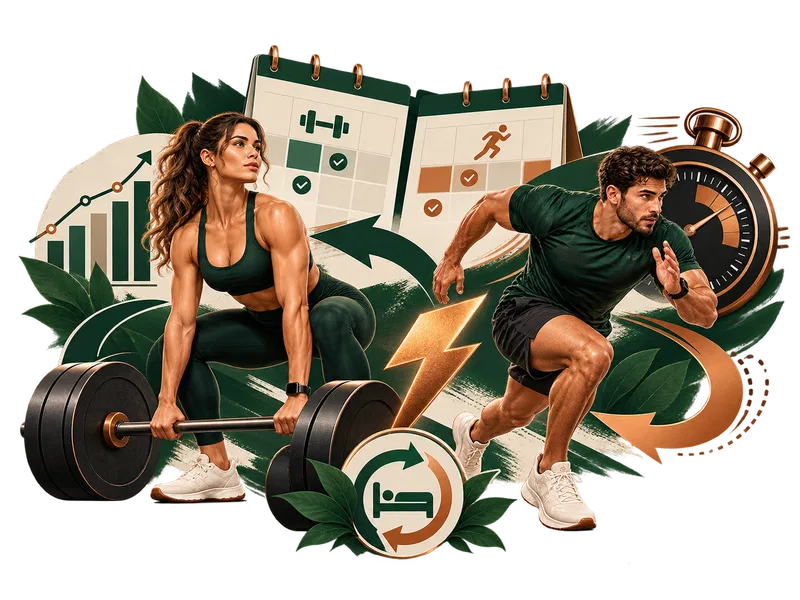
A 12-week study of 32 men examined strength training with or without lower-body high-intensity interval training (HIIT), including combinations targeting the same or different muscle groups. Squat movement speed declined in the group combining lower-body HIIT and lower-body lifting. However, the key comparison of changes between groups was not statistically significant.[2]
That is not proof that cardio ruins your gains. An older review of 43 studies found no clear reduction in muscle growth or maximum-strength gains from combined training overall. Explosive-strength gains were somewhat lower, particularly when both types of exercise occurred in the same session.[3]
For a speed, jumping, or power goal, consider separating demanding leg conditioning from your priority strength or power session. Track performance and recovery before deciding whether the change helps. General-fitness clients do not need to abandon combined workouts based on this small study.
Research details & confidence
Low-to-moderate confidence in the new study's interference signal. The group-by-time comparison was p = 0.083. A decline inside one group does not establish that it changed more than the comparison group. The earlier synthesis provides broader context, not a guarantee about every schedule.[2][3]
Train movement—not only the sport.
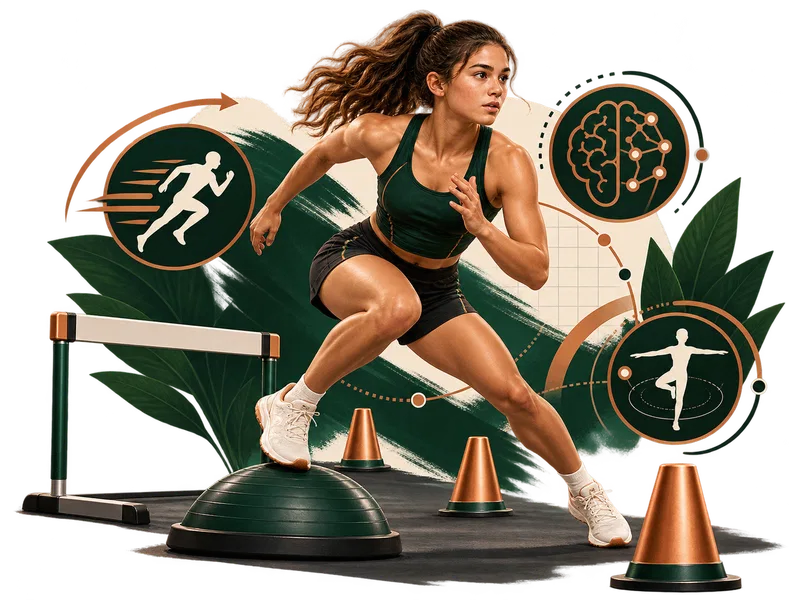
In a randomized trial, 24 trained female sprinters ages 16–18 completed either eight weeks of integrative neuromuscular training or traditional sprint-specific training. The intervention group improved more on several balance, hopping, strength, sprint, and jumping measures.[4]
The findings are promising, but they come from a small, specific group. Better balance or more similar performance between legs does not prove that injuries were prevented.
For an appropriate young athlete, discuss supervised single-leg strength, balance, and controlled landing practice alongside sport training. These are coaching applications to individualize—not a claim that we have reproduced the study's exact program. Use repeatable performance checks rather than chasing a perfect symmetry score.
Research details & confidence
Moderate confidence for short-term performance in this population; limited confidence for broader claims. Only 12 athletes were in each group. Several statistical effects were large, but the abstract did not report the sprint differences in seconds or jump differences in distance. Long-term benefits and injury outcomes remain unestablished by this trial.[4]
Painkillers are not a workout strategy.
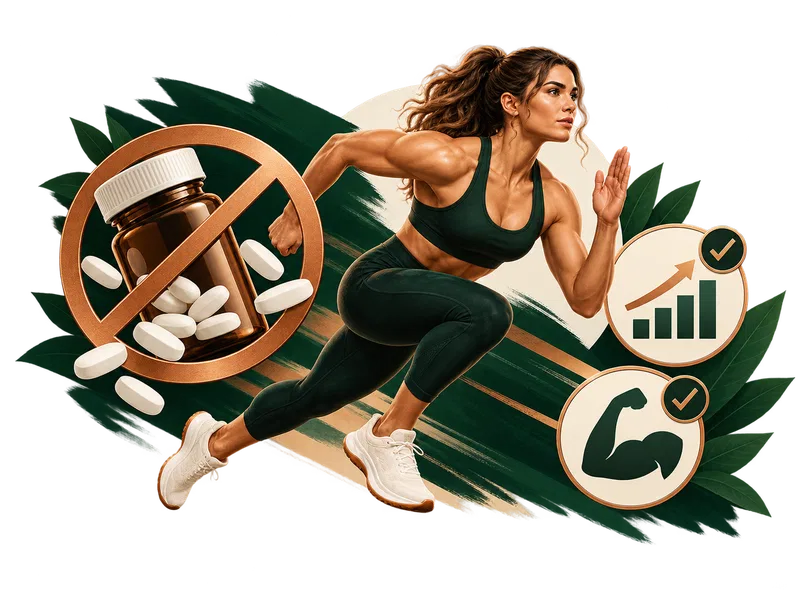
A systematic review pooled 23 randomized, placebo-controlled crossover studies examining pain medications during exercise in people who were not already in pain. The overall performance effect was very small and judged unlikely to provide a useful benefit.[5]
A statistically detectable effect is not necessarily a worthwhile training advantage. The review does not support treating pain medication as a routine performance supplement, and it is not a drug-by-drug safety assessment.
Do not start taking pain medication just to improve a workout. Discuss exercise-related pain or medication questions with a qualified clinician or pharmacist. Do not stop or change prescribed treatment because of a fitness article.
Research details & confidence
Moderate confidence, consistent with the authors' evidence rating. The pooled standardized effect was 0.14—not a 14% improvement. Different medications and exercise settings were combined, and a tramadol cycling subgroup required further confirmation. These mostly acute comparisons do not establish long-term training benefits.[5]
Use research to refine your plan—not replace it every week.
Start your next coaching conversation with one question: “What is the most useful adjustment for my goal right now?” Bring your workout log, the sessions that feel hardest to recover from, and the progress you want to see.
These papers do not test a new diet or supplement plan. This review therefore offers no new weight-loss or sports-nutrition protocol.
Choose a relevant change, agree on what to monitor, and review how it works for you. A research headline is a starting point for that conversation—not a personalized prescription.
Sources & how to read this review
The four recent studies were assessed from their original indexed abstracts, not a full-text methodological review. Confidence labels are informal editorial judgments. The older concurrent-training review is included as background, not new research. The earliest publication date of source 2 could not be independently resolved, so it is not presented as a new study from this week.
- Ferrari O, et al. Time course of muscle hypertrophy with and without progressive overload. International Journal of Sports Medicine. October 15, 2026. Read original record DOI: 10.1055/a-2980-6473
- Feuerbacher JF, et al. Combined aerobic and strength training: movement velocity and muscle-group overlap. [Shortened title] Journal of Strength and Conditioning Research. 2026; current PubMed page displays October 19. Read original record DOI: 10.1519/JSC.0000000000005595
- Schumann M, et al. Compatibility of Concurrent Aerobic and Strength Training for Skeletal Muscle Size and Function: An Updated Systematic Review and Meta-Analysis. Sports Medicine. Online November 10, 2021; March 2022 issue. Read original record DOI: 10.1007/s40279-021-01587-7
- Yang X, Li G, Huang J, Li C. Integrative neuromuscular training in adolescent female sprinters: a randomized controlled trial. [Shortened title] Sports Health. October 17, 2026. Read original record DOI: 10.1177/19417381261490670
- Franco-Alvarenga PE, et al. Analgesics and Exercise Performance in Pain-Free Situations: A Systematic Review and Meta-Analysis. International Journal of Sports Medicine. October 16, 2026. Read original record DOI: 10.1055/a-2957-1021
Educational information only—not individualized medical advice, a diagnosis, or a replacement for care from a qualified professional. Practical examples are coaching interpretations, not additional findings from the studies.